In this article:
- How artificial intelligence is already used in modern armies
- Real examples from current conflicts and global programs
- The countries leading AI development for defense
- What the future battlefield could look like under machine decision-making
A new kind of weapon
Artificial intelligence is no longer a laboratory experiment.
It is already a tool used by soldiers, analysts, and engineers in active war zones.
From drone targeting to logistics planning, AI systems now influence how battles are fought and how decisions are made.
The war in Ukraine has shown this most clearly. Both sides use drones guided by algorithms that recognize targets, correct flight paths, and sometimes complete missions even when communication is lost. What was once science fiction — machines making real combat decisions — is slowly becoming normal military practice.
Where AI is already used
Modern armies now use AI in several concrete areas:
1. Reconnaissance and intelligence.
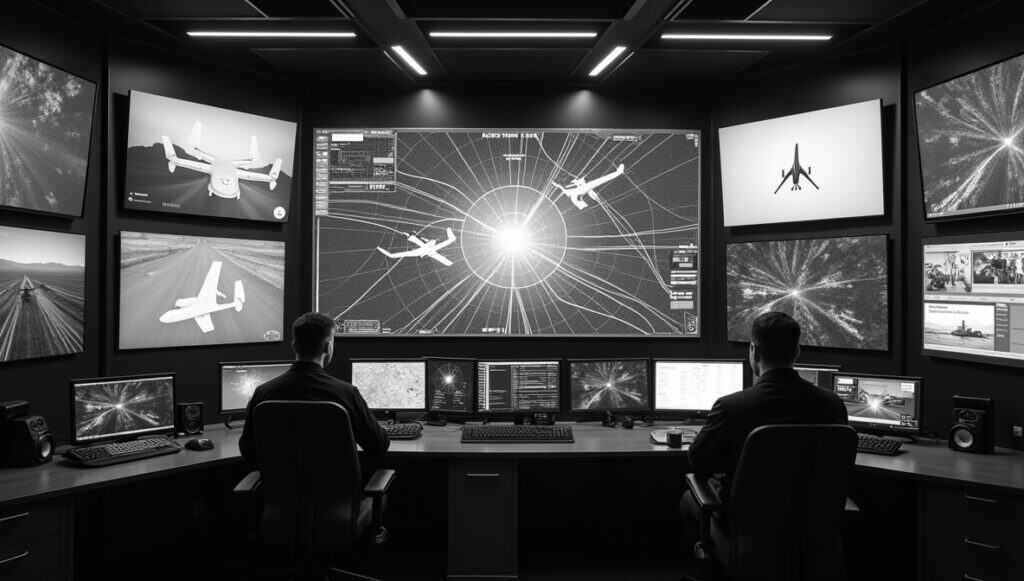
AI helps analyze thousands of hours of satellite and drone footage. Algorithms detect vehicles, artillery positions, or troop movement faster than humans can. Systems like the U.S. Project Maven were built exactly for this — to automatically flag possible targets in a sea of raw data.
2. Targeting and artillery.
Algorithms calculate firing solutions, estimate wind, terrain, and range, and adjust coordinates for precision strikes. In Ukraine, several artillery systems already use software that shortens the time between spotting a target and firing on it — sometimes from minutes to seconds.
3. Drones and autonomous vehicles.
Loitering munitions (“kamikaze drones”) can follow a target, avoid jamming, and strike even without constant human control. Ground robots are being tested for supply runs and casualty evacuation. These are still supervised, but their navigation and obstacle avoidance are fully autonomous.
4. Logistics and support.
AI predicts when a tank or aircraft will need maintenance before it breaks down. It plans supply routes and helps coordinate convoys through dangerous terrain. This reduces downtime and risk, saving both equipment and lives.
5. Cyber and electronic warfare.
AI tools scan massive amounts of network traffic and radio signals to detect interference or attacks faster than any operator could. In an environment where milliseconds matter, machines already make the first defensive moves.
Who leads the race
Several countries and private companies dominate this field.
The United States invests the most, with the Pentagon, DARPA, and private firms like Anduril and Palantir developing AI for drones, data analysis, and battlefield command systems.
China combines its tech giants and state military programs to create AI systems for surveillance, targeting, and autonomous weapons.
Israel is a leader in operational use, especially through companies like Elbit Systems and the success of autonomous drones used for real-time reconnaissance and strikes.
Russia and Ukraine have both accelerated field innovation — Russia focusing on automated artillery systems, Ukraine on low-cost drone swarms guided by machine learning.
These examples show that AI is no longer a futuristic side project. It is a new industrial and military race, similar in importance to the nuclear competition of the 20th century.
Where AI is heading next
The next step is not just smarter drones or faster computers — it’s decision-making.
AI will soon decide which targets matter most, how to allocate ammunition, or when to retreat.
Commanders may receive suggestions from software that has already calculated millions of possible outcomes.
This kind of “machine advice” could change the balance between speed and control: wars fought faster, but with less human reflection.
Another frontier is swarm warfare — groups of drones acting together, communicating locally without direct human orders. Early versions have already been tested in Ukraine and the Middle East. They can confuse radar systems, overwhelm defenses, and coordinate attacks on their own.
In support roles, AI will likely dominate logistics, maintenance, and health care — predicting shortages, rerouting supplies, and organizing evacuations automatically.
The armies that master this first will move, shoot, and recover faster than anyone else.
The limits and risks
Despite progress, AI in warfare faces serious limits.
Machines still make mistakes. They can misidentify civilian objects, fail under poor weather, or be tricked by enemy decoys.
Legal and ethical systems have not caught up — if an AI-guided drone kills civilians, who is responsible: the soldier, the programmer, or the state?
Many countries insist on keeping a “human in the loop,” meaning a person must approve every lethal action. But as reaction times shrink, that line will blur. The temptation to let algorithms act instantly will grow.
Conclusion — the future battlefield
AI will not replace soldiers, but it will shape every part of how they fight.
It already guides eyes in the sky, hands on the trigger, and decisions in command centers.
The next wars will be fought by humans and machines together — one thinking fast, the other deciding faster.
The real question is not if AI will change warfare, but how much control humans will be willing to give up.
That choice will define not just future armies, but the future meaning of responsibility in war.