In this article:
- How the Ukraine war reframes Russian–Chinese relations
- Why Chinese technology has appeared on the Ukrainian side
- What this reveals about the limits of strategic partnerships
- How global technology flows override geopolitical expectations
The Ukraine War as a Test Case
The war between Russia and Ukraine, which began in 2022, has evolved into a prolonged and adaptive conflict. What initially appeared as a conventional military campaign has turned into a war defined by logistics, technology, and sustained external support. Over time, the conflict has also become a practical test of international relationships that exist beyond the battlefield.
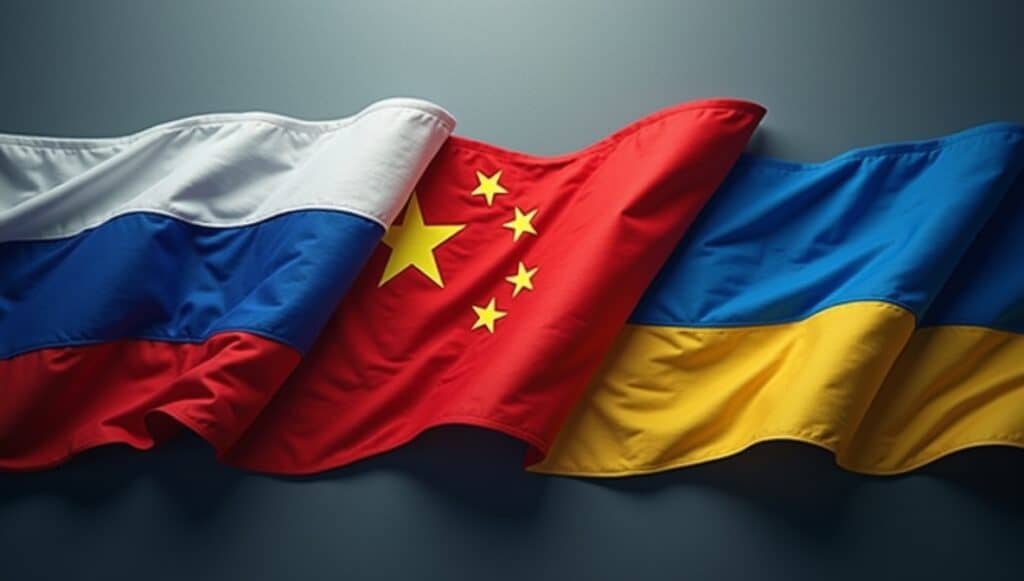
Seen from this perspective, relations between Russia and China offer a particularly instructive case. While official rhetoric emphasizes partnership and strategic alignment, developments linked to the war suggest a more conditional and fragmented reality.
Strategic Partnership in Theory
Russia and China have repeatedly described their relationship as a strategic partnership built on shared interests, economic cooperation, and a common skepticism toward Western-led global order. Energy trade, diplomatic coordination, and symbolic gestures of alignment have reinforced the image of a durable geopolitical axis.
The Ukraine war, however, has shown that such partnerships are not uniform across all domains. Political alignment does not automatically translate into operational coordination, particularly when economic exposure and technological risk are involved.
Technology as an Unintended Indicator
One of the more revealing signals has been the appearance of Chinese-made technology in Ukraine. Various forms of commercially produced equipment—most notably drones, communications tools, and electronic components—have been observed in Ukrainian use. This has attracted attention precisely because it appears to sit uneasily with the narrative of close Sino-Russian ties.
The significance of these observations lies not in any claim of direct state support. The technologies in question are overwhelmingly civilian or dual-use products originally designed for global markets. Their military relevance emerges only after adaptation, modification, or integration into improvised systems under wartime conditions.
Civilian Products and Military Adaptation
Once such products leave their country of origin, control becomes diffuse. They move through international distributors, private resellers, and third countries, often without clear visibility into their eventual end use. In this sense, the presence of Chinese technology in Ukraine reflects the structure of global supply chains more than any deliberate political choice.
This dynamic highlights the limits of state control over technology once it enters global circulation, particularly when products are designed for mass-market accessibility rather than restricted military use.
Diverging Risk Calculations
The war has highlighted differing risk calculations between Russia and China. Russia’s priorities are shaped by immediate military demands and sharply reduced access to Western technology. China, by contrast, operates under constraints defined by global market exposure, export controls, and the risk of secondary sanctions.
This divergence helps explain China’s emphasis on formal neutrality alongside a tolerance for indirect technological circulation. Strategic partnership persists at the diplomatic level, but it does not extend to actions that would impose significant economic or political costs.
Alignment in Practice
From Ukraine’s perspective, these distinctions matter little. Technology is adopted based on availability, effectiveness, and speed of deployment. In a conflict characterized by rapid adaptation, origin is secondary to function.
Viewed through the lens of the Ukraine war, Russian–Chinese relations appear less as a fixed alliance and more as a flexible arrangement shaped by risk management and systemic constraints.
Closing Perspective
The conflict has not undone Russian–Chinese relations, but it has clarified their limits. Strategic partnerships remain relevant as political frameworks, yet they coexist with global systems in which technology, markets, and supply chains follow their own logic.
Rather than exposing contradiction or hypocrisy, the war reveals a structural feature of contemporary international relations: alignment today is conditional, layered, and often constrained by forces beyond direct state intent.