In this article:
- A portrait of privilege surviving inside the Third Reich’s failing regime
- The persistence of balls, operas and hunting seasons during wartime decline
- The strategic denial embedded in elite social life
- The closing chapter of a world disappearing in slow motion
A Parallel World of Comfort in a Collapsing State
The upper layers of the Third Reich lived in a distinct, almost hermetically sealed environment. While the country mobilized for total war, high society preserved its routines. Private villas, diplomatic salons, weekend estates and exclusive cultural circles maintained a rhythm that had little in common with the reality outside. This was not simply denial; it was a structural separation. The regime allowed this parallel world to exist, and its elite participants embraced the insulation it offered.
The result was a system in which privilege acted as a buffer. The social calendar continued even as the broader political order showed signs of strain. The more volatile the situation became, the more determined this circle was to maintain an appearance of continuity.
Opera Houses Full, Bomb Shelters Nearby
One of the most striking characteristics of this era was the persistence of public display. Theaters, opera houses and concert halls remained active well into the war’s later phases. Attendance was high, even as cities were repeatedly hit by air raids. In Berlin, the audience might leave a performance to find neighboring streets destroyed. Yet the cultural apparatus kept its schedule almost intact.
These events were not mere entertainment. They were rituals of stability, symbolic reaffirmations of a social order that was visibly eroding. They allowed high society to behave as though collapse were a temporary disturbance rather than a structural failure.
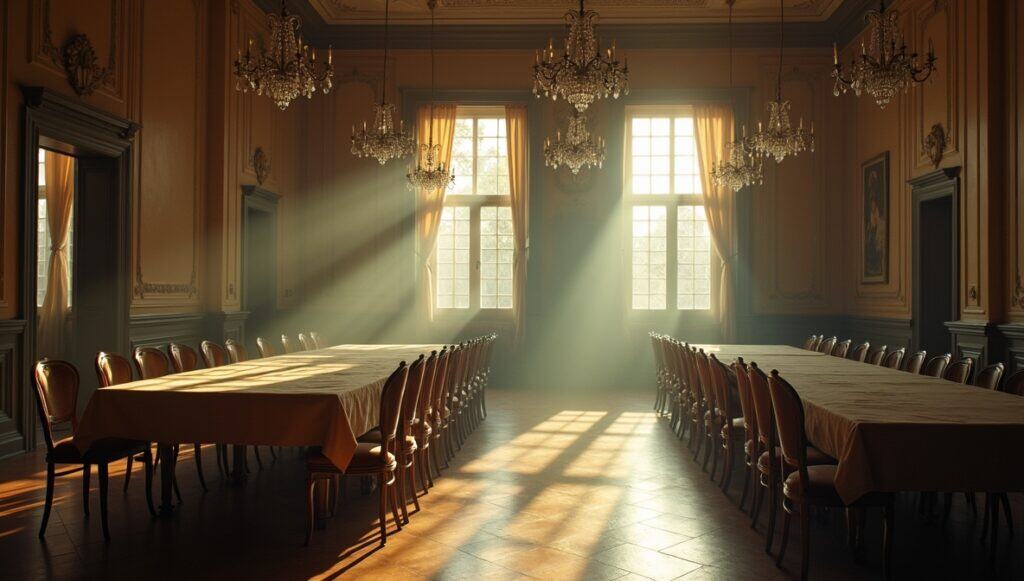
The contrast was stark: cities under bombardment, and at the same time, soirées illuminated by chandeliers in buildings that stood only by chance.
Hunting Seasons, Regattas, and the Illusion of Normalcy
Beyond the urban centers, the rhythm of privilege followed its traditional sequence. Hunting seasons continued. Country estates hosted their regular gatherings. Regattas and sporting events were organized despite the growing pressure on resources. These occasions functioned as social glue, preserving relationships within a class whose identity depended on ritual and continuity.
The war, even in its later stages, did not fully penetrate these circles. A deteriorating military situation often translated only into logistical inconveniences. The routines persisted until the state could no longer sustain even the illusion of normal life.
This endurance of refinement was not merely habit. It was a statement: the elite held to the belief that their world would outlast the conflict, regardless of the outcome.
Diplomats, SS Technocrats, and the Theatre of Power
High society in the Third Reich was not a uniform group. It blended the remnants of imperial aristocracy with new figures of the regime—SS functionaries, diplomats, industrial managers, cultural personalities. Despite their different origins, these actors shared a common investment in performance.
Private dinners remained stages for influence. Villas functioned as miniature courts. Artists circulated among political operatives, offering cultural legitimacy while benefiting from protection and access. The combination of aesthetics and power produced a social environment where the appearance of control mattered more than its substance.
This theatre of refinement continued even when strategic failure had become undeniable. The rituals persisted, as if repetition alone could sustain the system.
The Final Act: Caught Between Collapse and Celebration
In the last phase of the war, the gap between social behavior and political reality widened sharply. By the time defeat was visible on every front, high society still gathered for dances, dinners and cultural events. Some estates hosted celebrations weeks before they were overtaken by advancing armies. The champagne was still served. The orchestras still played. The social calendar still unfolded.
The collapse of the regime did not immediately collapse the performance. It was a final expression of a mentality shaped by privilege: the belief that the world, even at its end, would continue to provide comfort and continuity.
This was not merely indifference. It was a systematic refusal to acknowledge the scale of the catastrophe, a collective conviction that their sphere existed beyond the reach of consequences. In the final weeks, that conviction became unsustainable — but it did not disappear until the last possible moment.
Closing Reflections
The high-society world of the Third Reich offers a brief but telling glimpse into how privilege reacts to collapse. As the regime weakened, these circles did not scale back their routines — they intensified them. Balls, operas and private gatherings became a shield against acknowledging defeat.
This persistence did not alter the outcome of the war, but it reveals a pattern found in many failing systems: those closest to power often maintain their rituals the longest, convinced that the world around them will remain intact until the very end.