In this article:
- How queer activism and Palestinian solidarity became linked
- The main explanations: intersectionality, anti-imperialism, pinkwashing, homonationalism
- The contradictions between symbolic solidarity and social realities in Palestine
- Why activism often prioritizes symbols over lived conditions
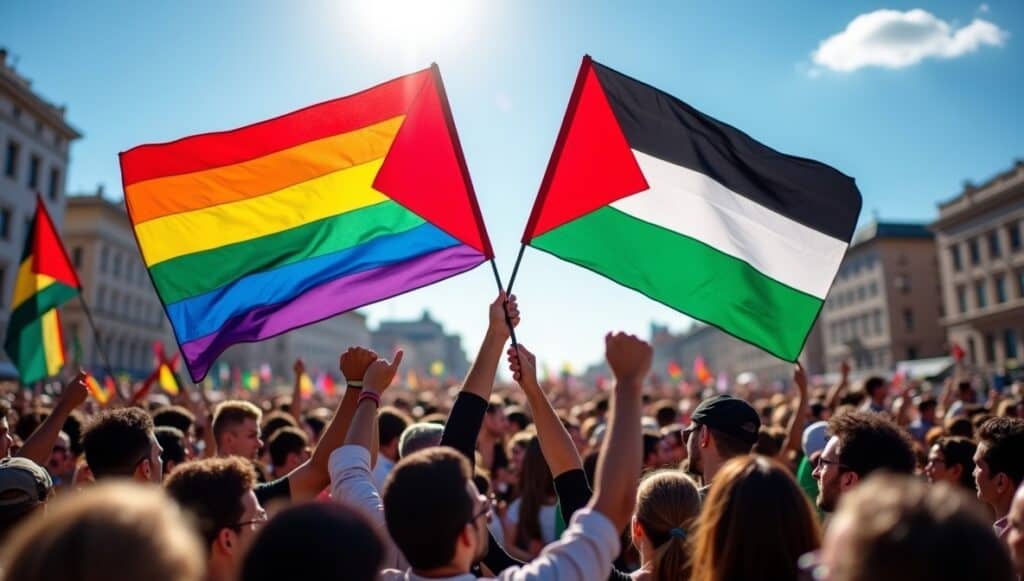
Rainbow flags wave next to Palestinian banners. At protests, queer activists chant “Free Palestine” with the same energy they show at Pride.
The scene looks colorful, dramatic — but also puzzling. Can someone explain this? Because the obvious question is: do these protestors know the realities of the region they claim to support? Palestine is not San Francisco. The majority of its population is Muslim. The dominant religious views toward women are conservative. Toward homosexuals, they are often outright hostile.
So why the alliance? Why would a group that celebrates sexual freedom support a society where that freedom barely exists?
A Short History Lesson
This is not entirely new. Since the 1970s, large parts of the Western left have supported the Palestinian cause, framing it as a struggle against colonialism and imperialism. Out of that tradition, queer activists eventually joined in. By the 1990s and 2000s, groups like Queers for Palestine appeared at rallies, usually alongside socialist and anti-war movements.
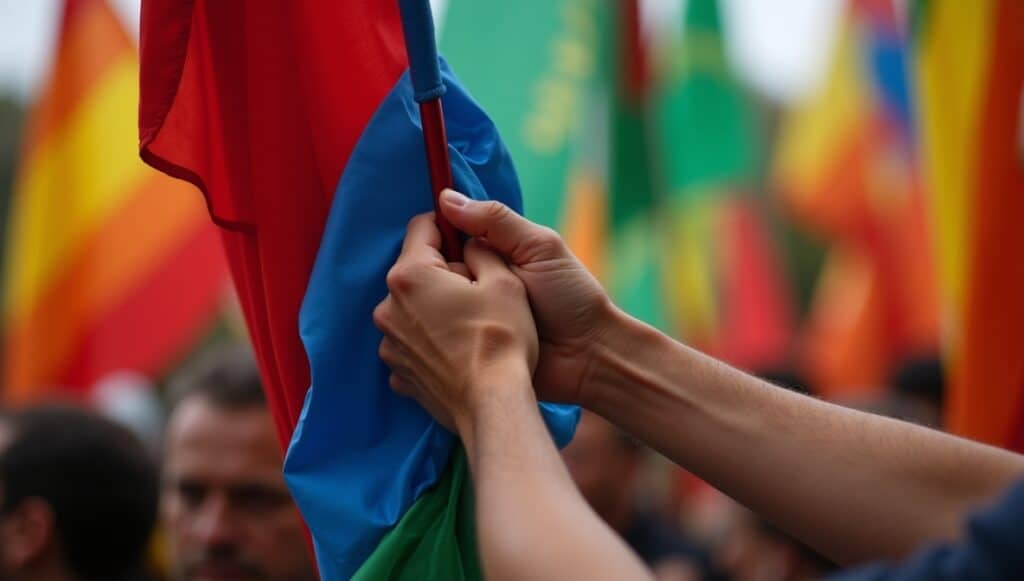
And so the imagery we see today was born: rainbow flags wrapped around shoulders next to keffiyehs — the traditional black-and-white checkered scarf that over time became a symbol of Palestinian resistance.
The Usual Explanations
- Intersectionality — the idea that all struggles are connected. Queer activists view Palestinians as another oppressed group and therefore natural allies.
- Anti-imperialism — resistance to Western power. For some, Israel is seen less as a country and more as an extension of U.S. influence. Supporting Palestine becomes symbolic opposition.
- Pinkwashing — accusations that Israel highlights its LGBT-friendly policies to distract from its treatment of Palestinians.
- Homonationalism — when states use LGBT rights to claim moral superiority. Activists reject being used in this narrative by aligning with Palestinians.
Global Echoes
Outside the West, the spectacle looks less inspiring. In the Middle East itself, rainbow flags at Palestine rallies are often ignored or ridiculed. Local societies know well that open queer life there is either underground or exiled. Meanwhile, in Western capitals, the same imagery is paraded as a badge of progressive virtue. The contrast is stark: loud solidarity on Western streets, near-complete silence on queer rights in Palestine itself.
The Contradictions
In Gaza, same-sex relations are criminalized. In the West Bank, they fall into a legal grey area but remain socially stigmatized. Reports from human rights organizations document cases of violence, persecution, and migration among queer Palestinians seeking safer environments abroad.
At the same time, international LGBT movements continue to frame their support primarily through the language of solidarity and resistance. For much of this activism, the focus is not on the lived realities of queer life in Palestinian society, but on the symbolic alignment with what is seen as an oppressed population.
This creates a paradox. The political message emphasizes unity against power, while the social conditions on the ground reveal deep contradictions that remain largely unaddressed.
What Should We Make of It?
The pairing of rainbow and Palestinian flags is striking. It communicates defiance, rebellion, and unity. Yet it also raises questions about how far symbols can stretch before they detach from the realities they claim to represent.
Modern activism often thrives on imagery rather than context. The combination of flags is powerful theater — a statement against power more than a reflection of lived experience.
In the end, the scene tells us less about daily life in Palestine and more about the way global movements construct solidarity. It is a reminder that in politics, symbols can travel further and faster than the truths behind them.